

Incarnation Part 1
An eldritch horror story.

In the central control room of the Tokyo Bay Aqua-Line, a thermal gauge needle snapped against the limitation pin. Deep in the ventilation shafts, sensors registered a forty-degree spike in under three seconds before the fiber optic feeds melted into static.
There was no time for the staff to transition from confusion to dread. The initial theory of a catastrophic seal-wall rupture—magma breaching the crust—died when the seismographs began to print. The needles drew a rhythm. It was low-frequency, wet, and biological.
The bay was boiling.
Thick columns of gray steam fogged the horizon, carrying a stench that hit the shoreline like a physical blow: sulfur, rot, and the sharp, copper taste of electrified blood. Thousands of fish surfaced, their scales bleached white and eyes cooked in their sockets, bobbing in water that had turned the color of deep, arterial mud.
On the Umihotaru observation deck, tourists filmed the discoloration, shouting over the wind about volcanic vents or chemical spills. They were still speculating when the ocean broke.
The dorsal ridge that cut the surface was jagged and uneven, looking less like biology and more like a tumor excised from the earth’s mantle. It breached the Kamata coastline and made landfall, dragging wet, red flesh onto the concrete.
Gravity should have been the weapon that killed it. Without the suspension of the deep ocean, the creature collapsed under its own mass, an infant thing spilling over the embankment like oil. It lacked forearms or balance, forced to plow through a retaining wall on its belly. Debris rained onto its back, ignored. The sirens wailing in the distance were ignored.
The gills along its neck flared, gasping for oxygen the air could not provide. They convulsed, expelling a torrent of superheated fluid—a radioactive slurry of seawater and blood that hissed as it hit the asphalt. Parked cars were stripped of their paint; tires dissolved into black puddles. The underground infrastructure began to cook.
The beast pushed deeper into the district with the terrified clumsiness of a drowning animal. A rudderless tail sheared through the support pillars of an overpass, sending a delivery truck tumbling off the creature’s flank. Its eyes, wide and chaotic, rolled in their sockets. It was suffocating.
A wet, strangulated gurgle tore through the district. The cry of burning lungs.
Then came the crack—louder than the collapsing buildings, like a sequoia snapping in a gale. A femur shattered, the leg twisting as muscle spasmed beneath the hide. But the bone didn’t stay broken. It knitted instantly, calcifying thicker, denser, and angled for verticality. The spine lengthened, ribs expanding and tearing open the chest skin to release a burst of small, bloody limbs that grabbed at the air.
The creature pushed. Concrete groaned, then gave way as newly formed legs drove down to find purchase on the bedrock.
It stood. The motion was jerky, a marionette pulled upright by an amateur hand, but it cast a shadow over the skyline it had previously crawled beneath.
The jaw unhinged, vocal cords hardening to produce a high, metallic screech that scraped against the glass of the skyscrapers. But the internal reactor was running too hot. The skin along its neck glowed a bright, angry orange, shimmering the air so violently that rain evaporated before touching the hide. The blood was boiling in its veins. The screech cut off, and the creature swayed, feverish and top-heavy, before turning back toward the water.
It collapsed into the bay. For three days, the water held its secrets. When the ocean parted again, there was no steam.
The shape that rose from the black water was finished. Raw flesh had calcified into matte, charcoal armor. At one hundred and twenty meters, it walked with the stiff, terrifying purpose of a mountain forced to mimic a man. It ignored the tank battalions lining the river. Artillery shells struck its hide and shattered, falling as harmless shrapnel.
The response from the air was silent. High above the cloud layer, stealth bombers released GBU-57 Massive Ordnance Penetrators. The impact struck the dorsal spine, a blast of red light illuminating the clouds as a dorsal plate the size of a house sheared off.
The creature stopped. The pain registered.
The lower mandible unhinged, dropping open like a broken drawbridge. A heavy, rolling smog tumbled from the throat, flooding the streets. A spark ignited deep within the gullet, and the atmosphere caught fire.
The street level ceased to exist. A wall of flame rushed through the city, turning concrete to glass and softening steel frames until they bowed. The creature leaned forward, the fire in its throat condensing into a beam of pure, violet light. It sliced through the smoke, silent and absolute. Three skyscrapers were severed at the midsection, the upper halves sliding off to crash into the inferno. The head tilted back, sweeping the sky, and at thirty thousand feet, the bombers were cut in half, raining down like burning confetti.
The counter-measure was thermodynamic. Cranes extended over the towering head, pouring thousands of gallons of coagulant and freezing agents into the open maw. The reactor fizzled. The coolant froze the blood from the inside out, plummeting the core temperature to one hundred and ninety-six degrees below zero.
It stood in the center of the graveyard, a black monolith frosted in white. The jaw hung open, frozen in a scream that no longer carried sound.
On July 14th, thermal cameras caught the variance. A fissure opened along the underside of the tail, releasing a deluge of thick, amniotic fluid. The solids followed—hundreds of shapes tumbling from the opening, striking the ground with wet thuds. Seven feet tall. Skin the color of bleached bone. No eyes, just rows of needle-teeth.
In the subway tunnels beneath the exclusion zone, platoons went dark. Helmet-cam footage recovered later showed the humanoid creatures standing perfectly still in the dark, tilting their eyeless heads. They were listening. When they opened their mouths, they repeated the tactical commands of the dead squad leaders, using stolen voices to lure soldiers into kill-boxes.
The strategy shifted to physics. Thermobaric ordinance flattened the remaining structures, the pressure waves rupturing the lungs of the brood. Thousands of the skeletal shapes fell simultaneously.
Dust settled. The sirens stopped. Seven years of incubation began.
The world rebuilt around the wound. A concrete sarcophagus encased the exclusion zone. Normalization set in with terrifying speed. Trains ran on schedule. Children entered elementary school knowing the God only as a statue, a fixture of the skyline. Souvenir shops sold keychains of the frozen beast while office workers stepped around the doomsday cults chanting at the perimeter wall.
The radiation counters in the subways became background noise. We lived in the shadow of the apocalypse and complained about the rent.
On a clear Tuesday at noon, the concrete sarcophagus detonated. There was no seismic warning; the barrier simply shattered outward.
The ice was gone. The obsidian skin glistened, wet and black, but the silhouette had mutated. Massive crystalline structures jutted from the shoulders, quartz-like and translucent. They unfolded, spanning kilometers—wings that shimmered, manipulating air pressure to turn the atmosphere into a solid surface.
The Deity levitated, rising until it hung in the stratosphere, a cross of black shadow against the sun. Beams of violet light erupted from the crystal tips, intersecting the flight paths of responding jets with mathematical precision.
Then came the exhalation. A fine, glittering dust drifted down, covering the ocean and land. The sky bruised purple, the radiation trails refracting the sunset into a toxic neon smear.
In the crater of an old reactor site, engineers engaged the lure—a fusion array with a heat signature that washed out satellites. The brightest thing on Earth.
High above, the biological imperative to feed overrode tactical advantage. The creature fell like a meteor. The impact shook the main island to bedrock, shattering the crystalline wings into a heap of broken limbs and bleeding light. Artillery batteries opened fire.
The torso split down the center. Ribs cracked and expanded to form a fortress wall. Two heads rose from the ruin of the shoulders. It was doubling in size, becoming a quadrupedal mountain of muscle and armor.
The Trident II missile arced over the Pacific. The flash was brighter than the sun.
For a moment, the glass-lined crater was empty. The bones had vaporized. But then, the bottom of the pit began to bubble. A red liquid rose rapidly, swallowing the glass walls. The heat of the warhead had liberated the cells from the limitations of a skeleton.
The biomass breached the rim, a tide of living fluid moving uphill. Billions of bubbles rose to the surface, popping to reveal eyes—human, reptilian, unblinking—staring up at the drones. Teeth formed on the crests of the waves, gnashing at the air.
When the fluid reached the coastline, the water turned a violent, opaque red. The data analysis was cold and clear: The entity was no longer trying to exist on the planet. It was trying to become the planet.
Operation Cryostasis II mobilized the industrial output of the remaining nations. Millions of tons of chemical ice froze the living sea mid-break. The waves hardened into jagged peaks of frozen meat. The eyes staring up from the muck glazed over, trapped under the ice.
The world survived on the back of a sleeping deity. Deep beneath the Red Zone, the temperature rises by 0.01 degrees every year.
But the containment leaked.
On the periphery of the Red Zone, in a valley shielded from the nitrogen wind, a drone conducting a botanical survey flagged a patch of color against the gray ash.
It was a cluster of wild mountain roses, blooming with impossible vibrancy out of the shattered windshield of a crushed sedan. The camera zoomed in. The roots were wrapped tight around the skeletal remains inside the car, thick, pulsing vines fusing bone to stem, drinking from the marrow.
The veins in the leaves pulsed with a faint, purple luminescence. The largest bud in the center of the patch unfurled. It didn’t hiss. As the heavy, velvet petals opened to reveal stamens that looked uncomfortably like needle-teeth, the audio sensors picked up a sound.
It was a soft, rhythmic weeping.
Author’s Note
Incarnation Part I, the veil is lifted. This is Godzilla, unmistakably so, yet stripped of any sense of heroism or balance.
I wanted to craft a creature that feels bigger than the world attempting to hold it—something born from pressures that do not belong to biology or geology. I wanted to capture the cosmic, the unknowable, and the quiet enormity of forces that do not notice us until we are standing in the wrong place.
To ground this impossible scale, I chose a narrative format often utilized in Japanese and Korean storytelling: the intersection of the Light Novel and the Documentary. There are no main characters here to save the day. By adopting a detached, panoramic perspective that chronicles the destruction with historical distance, the story shifts the focus entirely to the entity itself. It is not a battle; it is a record of an apocalypse in progress.
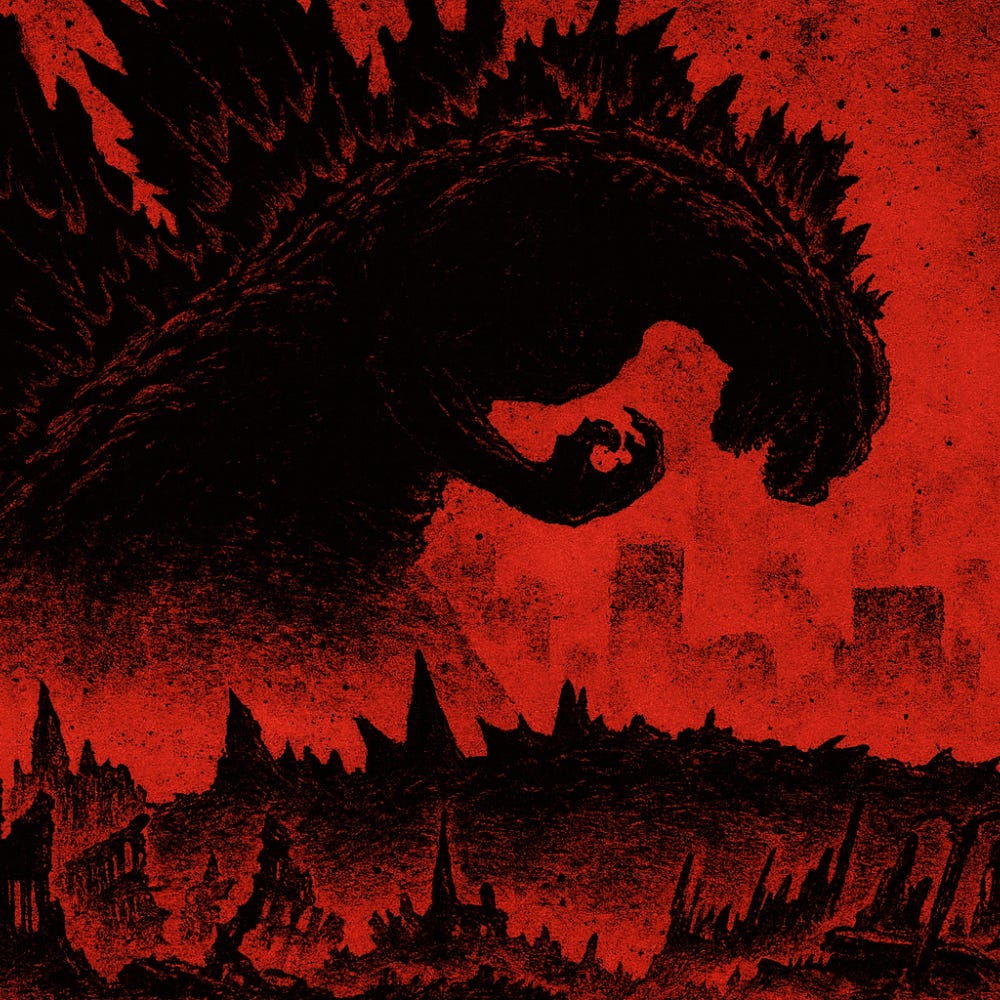
Visually, I needed an art style that could carry this weight. We moved away from traditional kaiju aesthetics to embrace something starker—a style that echoes the iconic, blistering red and black of Shin Godzilla. It is the color of arterial spray and charred bone, capturing the ancient, radioactive horror of the creature’s nature.
But this is only the first emergence. The universe around this entity is still expanding in the dark, waiting for its other inhabitants to step forward. There are other shapes moving just beyond the edge of the page, and the ice is already beginning to crack.
Have you ever read anything from Dino Buzzati? He had a story way back when similar in tone - about a giant hand reaching down to earth.
You do dark brilliantly, John!